
Beachfront Property
Texas starts to make waves in its newest sport

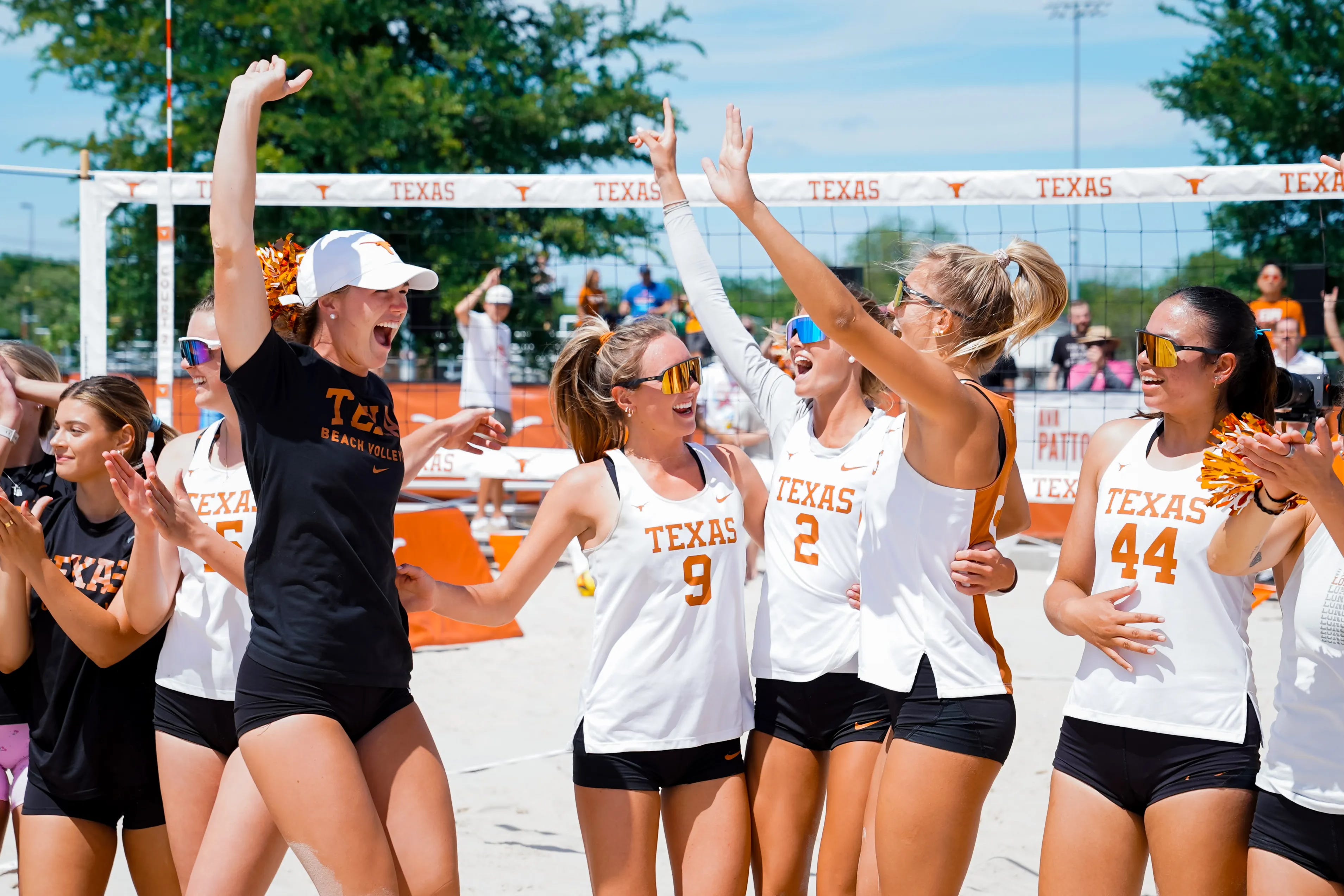
We’ve done pretty well in this reboot (restart? rehash? re-woopswestoppedwritingforabitbutweareback?) of Point Texas in covering a lot of subjects of interest concerning both current and former players of Texas’s indoor volleyball team. Josh has tracked roster shakeups. I've checked in on alums in the new pro league. It’s been a good way to jump back into the mission Josh had started this Substack with last year - trying to increase focus on the Longhorns’ historic decade-plus of play under Coach Elliott and to get the fanbase to open up their tunnel-vision to include more than just football. I’d say we are doing okay so far.
But to borrow some football terms (and hopefully get the attention of that pigskin-hungry fanbase), in the false start that occurred last year and our delay of game in creating content this spring, we’ve fumbled a bit (last football pun, promise) by not talking about one of the most exciting new additions to the Forty Acres: beach volleyball. In 2023, Texas added a new sport to its already impressive cadre of women’s and men’s teams across the athletic program. And with two seasons in the books, the Longhorns beach volleyball team has already shown impressive growth and thrilling potential.
The beach comes to Austin (sorta)
Ok, before we dive into where this team has been and where it may be going, let’s first break down the most obvious question: why male models beach volleyball? We won’t speculate as to why now was the time to add another sport to the Longhorn brand (although we love more points for the Director’s Cup!), but due to Title IX requirements, it was well-known that once Texas added another squad, it would be a women’s team.

Since Title IX’s passage in 1972, Texas has steadily expanded women’s athletics to ensure proportional representation in opportunities and scholarships. To address compliance issues women’s sports such as rowing, softball, and soccer were added in 1993. This is why you don’t see a men’s footy team out there at this time.
As much as I’d love to see the Longhorns add a gymnastics team so that Texas can find another sport to beat OU in, the capital and infrastructure needed for that will take some time (but in CDC we trust). Conversely, Texas has a very robust court volleyball program and existing facilities for beach volleyball in Wright-Whitaker Sports Complex. UT had already ceded the early jump on becoming the flagship beach program in the state as - dare I say it - TCU (yes, that sad purple school up north) had already jumped in, even reaching the semifinals in 2023. We’ll see later why TCU disgusts me even more in this regard.
Beach volleyball became the latest NCAA sport to culminate in a national championship each year starting with the 2016 season after final approval during the NCAA Convention the year prior. To understand how quickly the sport is growing collegiately, one only needs to look at the change in the number of teams: in 2012, there were only 15 Division I programs, and now there are over 100.
With the growth of the sport and the ability to rapidly kick-start the program, adding beach volleyball provided Texas with an opportunity to attract a broader range of student-athletes, particularly those who excel in both indoor and beach formats. This dual-sport approach can be appealing to recruits seeking diverse athletic experiences.
Moreover, beach volleyball competitions are often held in scenic outdoor settings, offering unique spectator experiences that can increase fan engagement and media exposure for the university's athletic programs. Austin’s continued growth as a destination for major outdoor sporting events (Formula 1, MLS, NASCAR, etc.) and multiple lakes for aquatic-based sports makes a lot more sense for the sport than DFW.
It looked like a match made in volleyball heaven, and if you thought it would take a long time for Texas to reach national relevance in a new sport, you’d be wrong.
But first: a coach. And probably some players.
Let’s be real: 2023 was never going to be a banner year, but it was a chance to lay a strong foundation, especially on the recruiting front. Both the 2023 and 2024 seasons were “exhibition” seasons with no postseason eligibility, but that did not mean the program could afford to take its time building itself up as a competitor.
Of course, you may have noticed I have some strong faith in Chris Del Conte (again, in CDC we trust!) after what have turned out to be some home run hires in several other sports, and he made no exceptions in the case of beach volleyball. CDC knew the absolute necessity of striking while the iron is hot by getting a solid recruiting and development system early while the sport is still rather underrepresented by other major athletic programs. In typical CDC fashion, he didn’t tiptoe into the shallow end; he went big game hunting.
Beach volleyball naturally lends itself to visions of picturesque Pacific beaches in the Golden State, and on the collegiate level it’s hard not to immediately think of the two powerhouses in Los Angeles. Of the eight NCAA beach volleyball championships from 2016 through 2024, UCLA had won two and USC had taken the other six. It should be no surprise then that CDC went to the current mecca of beach volleyball in the US when he shopped for a coach.
In May of 2023 UT hired Stein Metzger to lead the new program. A former UCLA head coach and an Olympic player of the sport in his earlier years, Metzger brought a wealth of experience to the Forty Acres. Metzger had started UCLA’s beach volleyball program himself in 2013 and was no novice at building a contender from scratch.
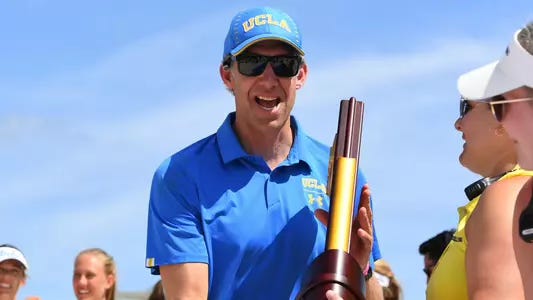
To help build a roster with literally zero ability to recruit out of the high school ranks in a traditional multi-year effort, Metzger turned to a pool of talent that happily was already on campus: the court volleyball team headed by Jerritt Elliot. What could be deemed a “pilot run” season in 2023 with a roster that looked eerily similar to the one that played in Gregory Gym that fall allowed the program to get some competitions under its belt as a foundation for future growth, even if the team went an unimpressive 1 and 12.
It may seem surprising that a roster full of national champions on the hardwood could only notch a single win in the sand, but it speaks to just how different the two games are. While some athletes do excel in both formats - a bonus for future recruiting under both Elliott and Metzger - the overlap has limits.
Court volleyball is played on slightly larger dimensions (18m x 9m) as compared to beach (16m x 8m), yet in court there are six players covering that playing surface versus just two in beach. Beach also has no substitutions, making stamina a pivotal component of a team’s performance. A slightly different scoring system as well as more stringent restrictions against open-hand tipping and double contacts during sets adds to the delta between beach and court volleyball.
Finally, there’s the playing environment itself: sand often varies by location in terms of texture, density, etc. (but I’m told is still hated by Anakin Skywalker regardless), and a little thing called wind that can affect the trajectory and speed of the ball in the air both add to nuances between beach volleyball and its indoor cousin.
Metzger needed athletes who lived and breathed the beach, and the transfer portal delivered.
You can go to hell, we’re going to Texas
The flagship university in the state of Texas finally adding a beach volleyball team served as a siren call to wayward natives who’d been hitching it out to California like it was the Great Depression. At least that was the case for Katie Hashman and Macie Butler (Austinites who had opted to play for UCLA coming out of high school) who transferred to the Longhorns prior to the 2024 season.
Ava and Carys Patton had originally committed to TCU (again, we don’t stan) for a chance to play in the sand while staying close to home, with Ava even suiting up for the Horned Frogs for her freshman year. Daughters of former Longhorn and NFL defensive lineman James Patton, the sisters bled burnt orange their whole life, but a love of beach volleyball meant looking beyond Texas was their only option (until now). The establishment of the program in Austin and the hiring of Metzger made hitting the portal an easy decision for Ava and allowed Carys to change her commitment to The Good Guys™.

With a few more transfers and the program’s first true high school recruits like Carys, Metzger’s sophomore squad featured ten Texans who hadn’t come over from the court team. Meanwhile, Elliott’s squad still lent some serious talent to the beach, with Jenna Wenaas, Marianna Singletary, Devin Kahahawai, Ayden Ames, Ella Swindle, Emma Halter, and Averi Carlson all moonlighting from Gregory Gym.
In total, the team had twelve players who were solely focused on the beach game, with ten of them originally from Texas.
Across any collegiate sport, keeping home-grown talent in state is a major component of building a successful program, especially if your state generates some of the best players. Texas does just that with beach volleyball. The Longhorns were able to exercise their revered brand throughout the state as well as the prestige around Metzger’s coaching legacy to pull players such as the Pattons from schools with much more established programs.
With its reloaded roster, the team showed marked improvement over its inaugural campaign. They fell just shy of a winning season - posting a 7–8 record - but the trajectory was undeniably positive. The 2025 season would bring Metzger’s first full recruiting class: his team, his culture, his system. And with it, Texas would put the beach volleyball world on notice.
Started at the bottom now we’re here
This is probably a good time to establish that the Southeastern Conference (SEC) is not a beach volleyball conference, despite how much some member schools make the conference their entire personality. The NCAA requires at least six member schools of a conference to sponsor a sport in order for that conference to hold its own rankings and championship. Like many emerging collegiate sports, beach volleyball doesn’t yet meet that threshold in most conferences.
When Texas joined the SEC on July 1st of 2024, they became the fifth program in the conference with a beach team, leaving it one shy of the cutoff. As such, Texas joined the Coastal Collegiate Sports Association (CCSA) when they established their program. Ironically, the season after the Longhorns left, the Big 12 hosted its first-ever beach volleyball championship.
The CCSA was established in 2008, initially focusing on men's and women's swimming and diving and was composed of various southeastern US schools that were homes to those programs. In 2015, the conference expanded to include women's beach volleyball, reflecting the sport's growing prominence at the collegiate level but lack of power conference representation.
In August 2023, the Atlantic Sun Conference (ASUN) absorbed the CCSA's swimming and diving programs, making the CCSA a one-sport league. If you haven’t heard of this beach-only conference before, you’re not alone; in fact, to quote Bones from Star Trek: “he’s dead, Jim.”
Texas joined major programs like Florida State, LSU, and South Carolina in the hodge-podge conference. With the addition of another cash-rich program, things were looking good for the CCSA. But conference realignment isn’t limited to the Power 5 - or I guess 4 now - conferences, and those four titans packed their flip-flops and headed west to the Mountain Pacific Sports Federation (MPSF) conference, starting with the 2025–26 academic year. Effectively, the CCSA was PAC-12’ed, and after 17 years of operation the CCSA is shuttering its doors.
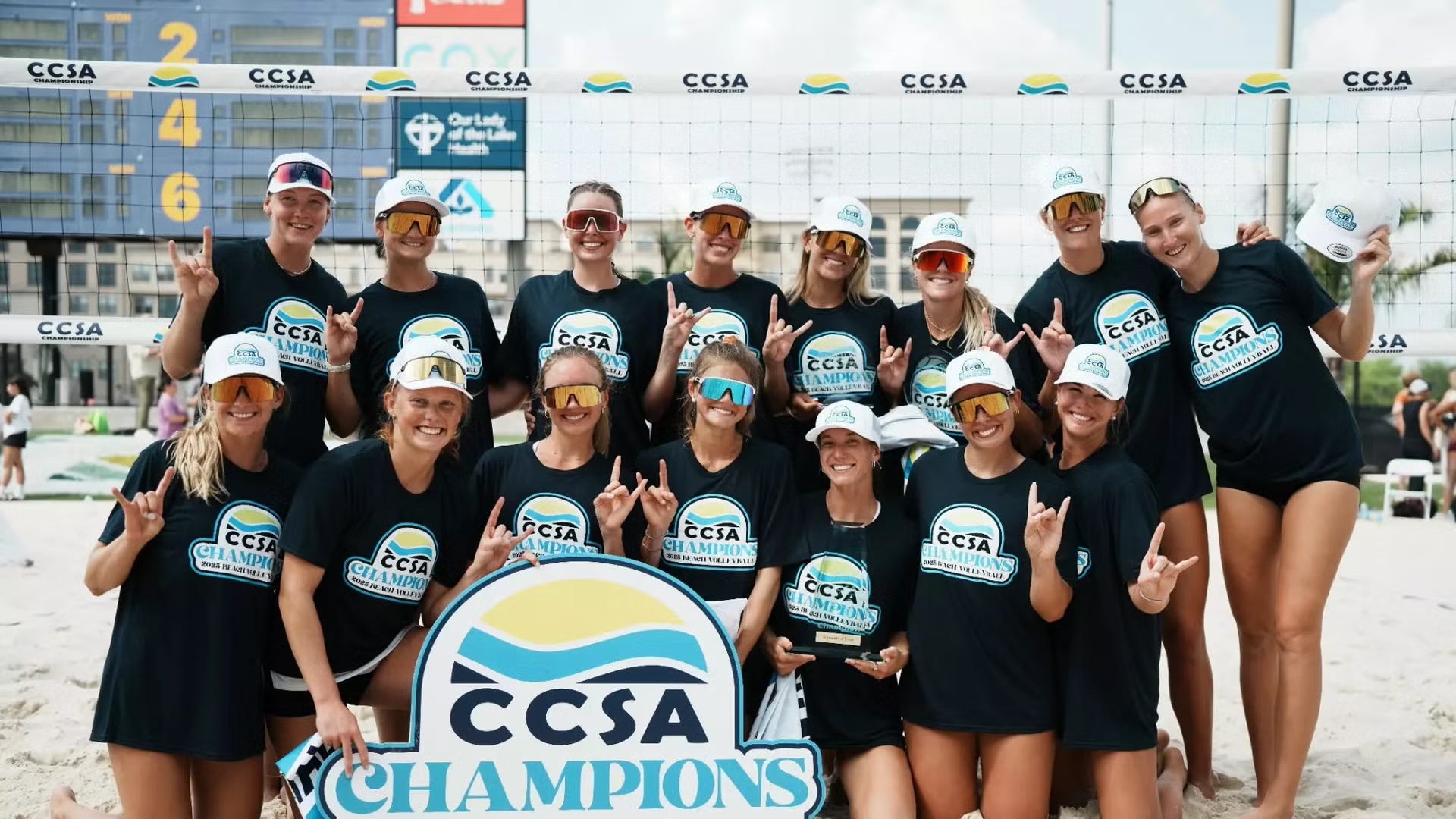
But first, the 2025 season had to play out, and much like how many of the other Longhorn teams decided to part from the Big 12 Conference with eternal scoreboard and a trophy in hand, the beach volleyball team decided to walk away on top.

In April 2025, Texas captured its first CCSA championship. The Longhorns secured a 3-0 victory over Florida State in the final, with pivotal wins from the No. 2, No. 3, and No. 4 pairs. Notably, the No. 3 duo of Maddison Parmelly and Karin Zolnercikova clinched the title with a 21-7, 16-21, 15-10 win.
Through both the regular season and the conference tournament, Texas had earned an impressive 27 and 9 record, indicating that Metzger’s recruiting and program-building was proving to be successful in his third year. The record and conference title earned the Horns a number seven seed in the NCAA tournament - the Longhorn’s first foray into the postseason.
Texas would take down the ten-seed California Bears in the first match of the tournament. Unfortunately, I did tease earlier that I had more reasons to loathe TCU, and the time has come to pull that ugly purple frog out of the magician’s hat. After winning the Big 12 Conference title, TCU came into the tournament hot and holding the number-two seed. The head start in developing a program, recruiting, and tournament experience that TCU has over Texas proved to give them the upper hand at this stage in Metzger’s tenure. The Horned Frogs took down Texas three to nil, ending Texas’ breakthrough season.
I’m not big on silver linings when it comes to losing to the eventual champion. TCU did go on to win the tournament outright and took home the NCAA title, ending the reign of only LA schools reaching that mark. Losing to the Horned Frogs wasn’t some symbolic victory in defeat; it only showed what work is still ahead of Metzger and this team to reach that pinnacle. But the Longhorns can and should take solace in the steady improvement and the fact that in only three years the program grew from scrapping together a roster of court volleyball players to conference champs with real national title odds.
And we’re on to Cincinnati (Boom! Gotcha with another football reference)
Right now, TCU may be the top dog in Texas beach volleyball, but all things must come to an end. It was only three years ago their football team was playing for a national championship, and now Sonny Dykes can’t even get a whiff of the playoffs. Meanwhile Sark and company are racking up elite hotel points in places like Atlanta, Dallas, and New Orleans.
The advantage for Texas is what we see in any sport the Longhorns play: this is the flagship school for the state. People from the state want to play here. People from other states wish their local schools had our clout and resources. Now, momentum is on Metzger’s side.
A winning record. A conference title. A clear upward trajectory. A strong indoor program feeding crossover talent. And, of course, the allure of Austin. It all plays into Metzger’s hands going forward in both recruiting and navigating the transfer portal. If Texas can continue this trajectory after another year of roster building and player development, the sky's the limit for this team. Texas will own this state in beach volleyball, as it does in so many other sports. And TCU can slink back into the shadows where second-tier programs belong, clutching that one moment of glory like it’s not about to be steamrolled by what's coming.