
Mailbag Mania
Answering your questions for our first-ever mailbag article


Welcome to our first-ever “Mailbag Mania” where we answer questions you submitted to us about anything and everything (but most likely nearly exclusively Texas volleyball). Not only does this allow us to go over topics that we might have overlooked some in the past, but it also gives us the opportunity to interact more with our community, something that is primarily left to Brittany as manager of the Instagram account in the regular day-to-day.
Before we even begin, we’ve already gained at least one major lesson learned: use the damn subscriber chat feature on Substack. We neglected to use that feature, and I think it cost us an opportunity to field more questions. For now, we have a solid five questions by way of the /r/LonghornNation subreddit to discuss courtesy of two total folks who asked them. Using the subscriber chat feature in the future may provide a better opportunity to engage for the mailbag.
While the…everything else…of the world is a chaotic mess, I at least hope you’ve been able to get some enjoyment out of the Winter Olympics. At the time of my starting this article, Team USA has a 2-0 lead over Canada in the preliminary rounds of the women’s hockey tournament, and we’re also fresh off taking an unfortunate loss in the gold medal match to Sweden for mixed doubles curling. We’re a short few days away from the start of the men’s hockey tournament, and that should be one for the ages with the return of NHL players to the Olympics for the first time since 2014.
Question 1: Who do you want to see Texas go up against in the tourney in Milwaukee given the pedigree of teams participating?
In case you missed it, Texas was recently announced to be one of the participants in the AVCA First Serve event in Milwaukee, WI which will serve as the opening salvo of the 2026 NCAA volleyball season. Texas A&M will start their national title defense (yucky) in Milwaukee alongside the other members of 2025’s Final Four in the form of Kentucky, Pittsburgh, and host Wisconsin. Rounding out what is absolutely a stacked cast of characters are Arizona State, Louisville, and SMU, all of whom were #2 seeds in last December’s national tournament.
Unfortunately, the organizers didn’t ask us for our opinions, so we already know that Texas will only be playing in one match at Fiserv Forum against the Arizona State Sun Devils on Saturday, August 22nd. That’s certainly a little bit of a letdown given A) only one game and B) Arizona State is a familiar face after their trip to Gregory Gym in 2025. Ideally, I would’ve liked to see Texas play SMU and Pitt, the only two teams Texas didn’t see last fall, but alas…
Q2: I was really impressed with our freshmen this season and I’m excited to see how they grow. Each freshman seemed to have a chunk of the season where they played great and a chunk where they were just so-so. I’m curious to what do you attribute [sic] these swings in performance?
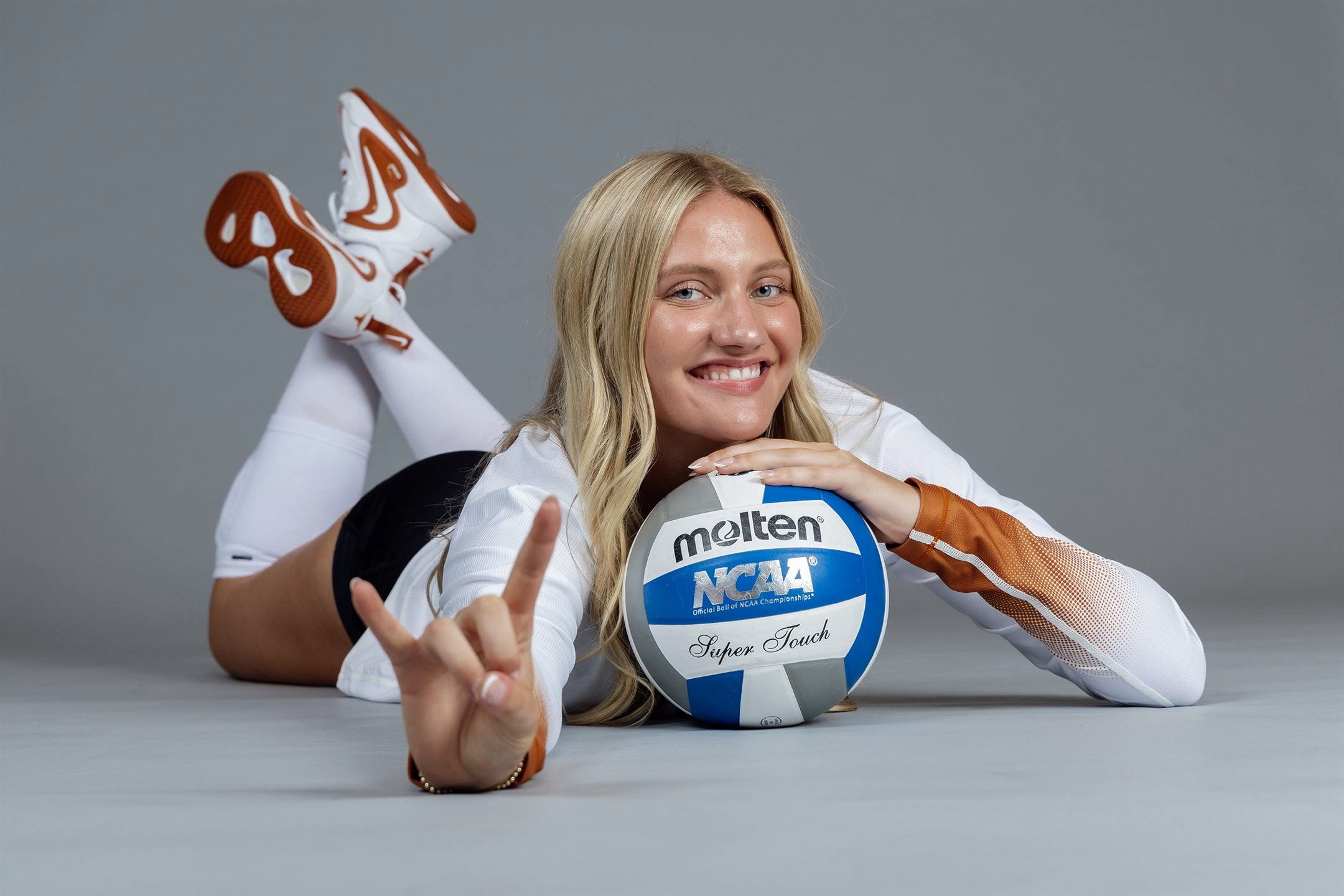
Brittany especially spoke at length during last season’s articles about the propensity of underclassmen - especially true freshmen - to be a bit inconsistent. More than that, I think modern volleyball has become a hugely tape-driven sport. There’s no more being sneaky with weaknesses for your youngest players; every team knows what every other team has already tried - both successfully and unsuccessfully - to solve a fledgling superstar. Taking that one step further: many of the players have been facing each other for years in the club scene and U19 national teams, so they know each other’s strengths and weaknesses very well.
It then comes down to the individual player and the coaches to evolve her toolbox week-to-week and match-to-match to help develop the strengths and minimize the weaknesses over time. That constant push-pull of “introduce tool, tool gets solved, introduce new tool” is the dynamic that drives development across all collegiate sports, but there’s an additional magnification in volleyball when players can be isolated in a game plan by the opposing team. Only baseball and softball are more challenging when it comes to being unable to hide a player’s weaknesses as they develop over time.
The good news is that the team has nothing but time in the offseason. Another spring for the rising sophomores to find their game can’t lead to anything but positive developments for each. Taylor Harvey merely getting her first spring in a college program will also be a huge boon. Between that time and the continued leadership of experienced stars like Torrey Stafford, it’s not much of a challenge to imagine Texas’ underclassmen providing far more consistency in 2026.
Q3: There was a noticeable drop off in clean, hard swings from Cari Spears in the 2nd half of the season? Seems like the competition wasn’t any tougher considering our OOC slate. Setting? Defensive adjustments forcing more variation? Something else?
Texas went through some rough stretches of passing and their transition game during the SEC calendar in 2025. Being able to provide a semi-consistent ball for Ella or Rella is a critical component in opening up the offense and thus involving the opposite in an effective way. Yes, it’s absolutely on the setter to “better” the ball and find a way to keep the offense flowing, but even with the best setter on the planet, a higher number of poorly-placed passes is going to result in playing out-of-system more.
It also brings us back to the conversation we had in response to Q2. As Cari played more, her game became more exposed to opposing coaches and players. There were fewer surprises when she started dominating from the right side, and defenses adjusted to account for the threat she posed.
To further complicate the situation, Texas’ well-documented blocking struggles during the SEC slate didn’t do the defense any favors. While digs were there, they weren’t necessarily as high-quality as one would hope, and that further put Texas out-of-system. With that large increase in out-of-system play, the setters are more likely to go to where they’re most comfortable, which is almost always going to be setting the left pin. Simultaneously, that will cause the rhythm with their opposite to degrade, something that’s already tenuous enough when your opposite is a true freshman still in the early days of ever playing the position, never mind just learning the speed of the game at the college level.
Q4: It’s been brought up that our blocking approach seemed to change as the season went on from a focus on pure blocks to generating more block touches/tips and perhaps back to pure blocks. What were you seeing with our block that was effective and where were the areas we could improve the most?
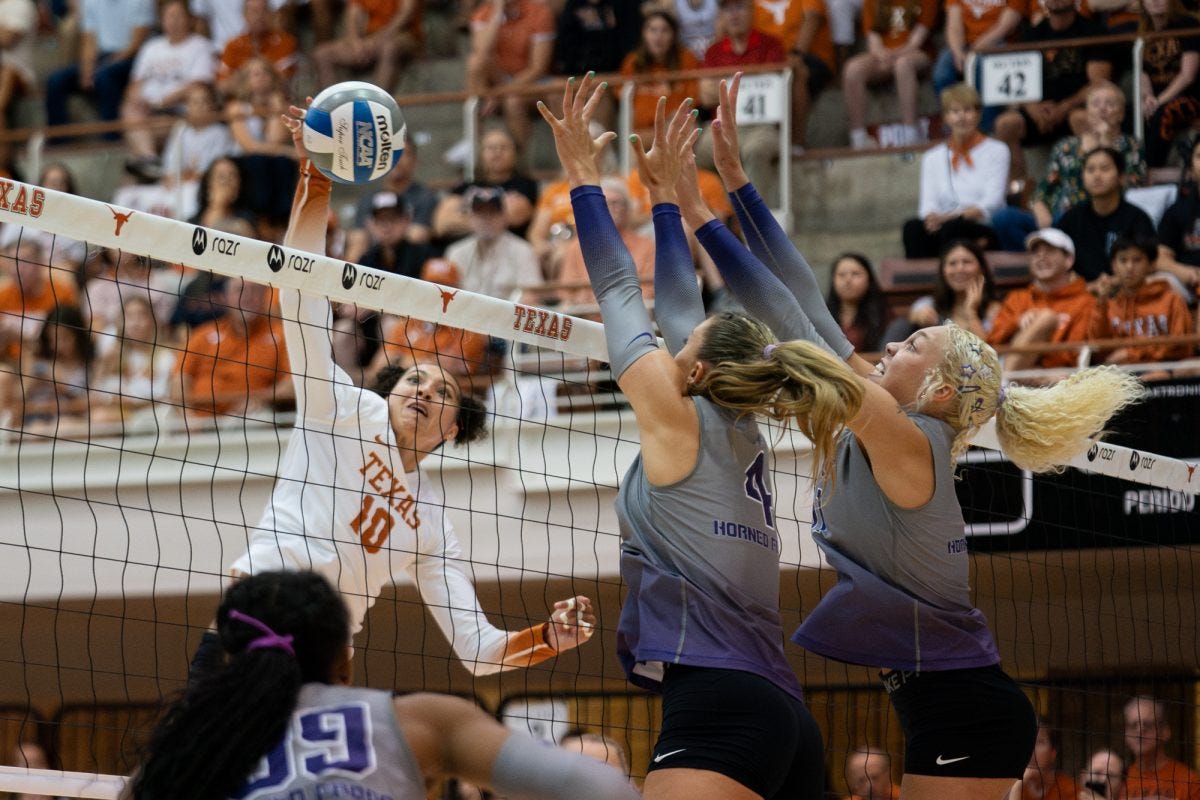
I don’t know that I would characterize our blocking scheme as having started with a focus on pure blocks. I think much of the offseason was spent building the new blocking scheme with that focus on touches to allow the back row to shine. I don’t think it is any coincidence that much of Texas’ late-season resurgence in terms of a suffocating block came in line with an increased reliance on the super-senior Whitney Lauenstein with the double substitution. It was likely a lot harder to de-program her blocking approach to match the new philosophy as a result of her amount of experience at the college level.
I think this offseason’s focus needs to be on establishing consistency and a reliable presence at the net defensively. Both Taylor Harvey and Nya Bunton flashed at times last season and seemed to only grow in confidence the deeper into the year Texas played. It’s especially important to remember that Taylor Harvey did not participate in spring practice last offseason; she didn’t arrive on campus until the summer. Simply being able to establish two experienced middle blockers and not feeling like we need to rely on very green true freshmen to play a significant number of rotations should alone lead to dramatic improvement from that room in 2026. Let’s hope we can find some depth behind them too.
Q5: Like blocking, serving is another area we’ve seen some Texas teams excel at while others struggle. How much of this is just getting reps and how much is this just something that a player’s “got”? How do we think next year’s serve game will compare with this year’s?
Strong service pressure is one of the best ways to make every other aspect of your team look better. Even if you aren’t necessarily scoring points by way of aces, forcing your opponent into uncomfortable positions while setting makes blocking and back row defense much easier, even if your philosophies in those areas undergo zero substantive changes. Service line is one of those skills in sports that appears to be totally divorced from the position one plays. While it is definitely a skill that can be developed with reps and intentional coaching, I do think there’s an aspect of it at the NCAA level where the players who are elite simply just possess some additional drive to be good at serving. In that sense, I don’t think it is wildly dissimilar from free throws in basketball, face offs in hockey, or penalty shots in soccer. At a certain point, you just need to have the right screws loose while also having a good grasp of the fundamentals. We saw Kenna Miller last year whip out a pretty wicked top spin serve despite little-to-no time on the floor otherwise, for example.
As far as next year’s chances of improved service pressure, I’m afraid I have little to share outside of a general shrug. Could be better. Could be worse. Could be the same. We’ve seen enough to know players like Torrey Stafford are good at it while the Ramsey Garys and Ella Swindles of the world aren’t necessarily known for delivering crazy service pressure. Nya Bunton and Rella Binney are both solid-to-good at the service line. After that, we have a lot of incomplete grades. I’ve heard rumors that Cari Spears spent a lot of last season in practice trying to work out the kinks on a top spin serve. We haven’t seen AVW or Taylor Harvey really get a fair shake at starting play either. Add the crop of true freshmen to the mix with whatever talents they might possess from position #1, and you’re left with one big question mark.
Sand Szn
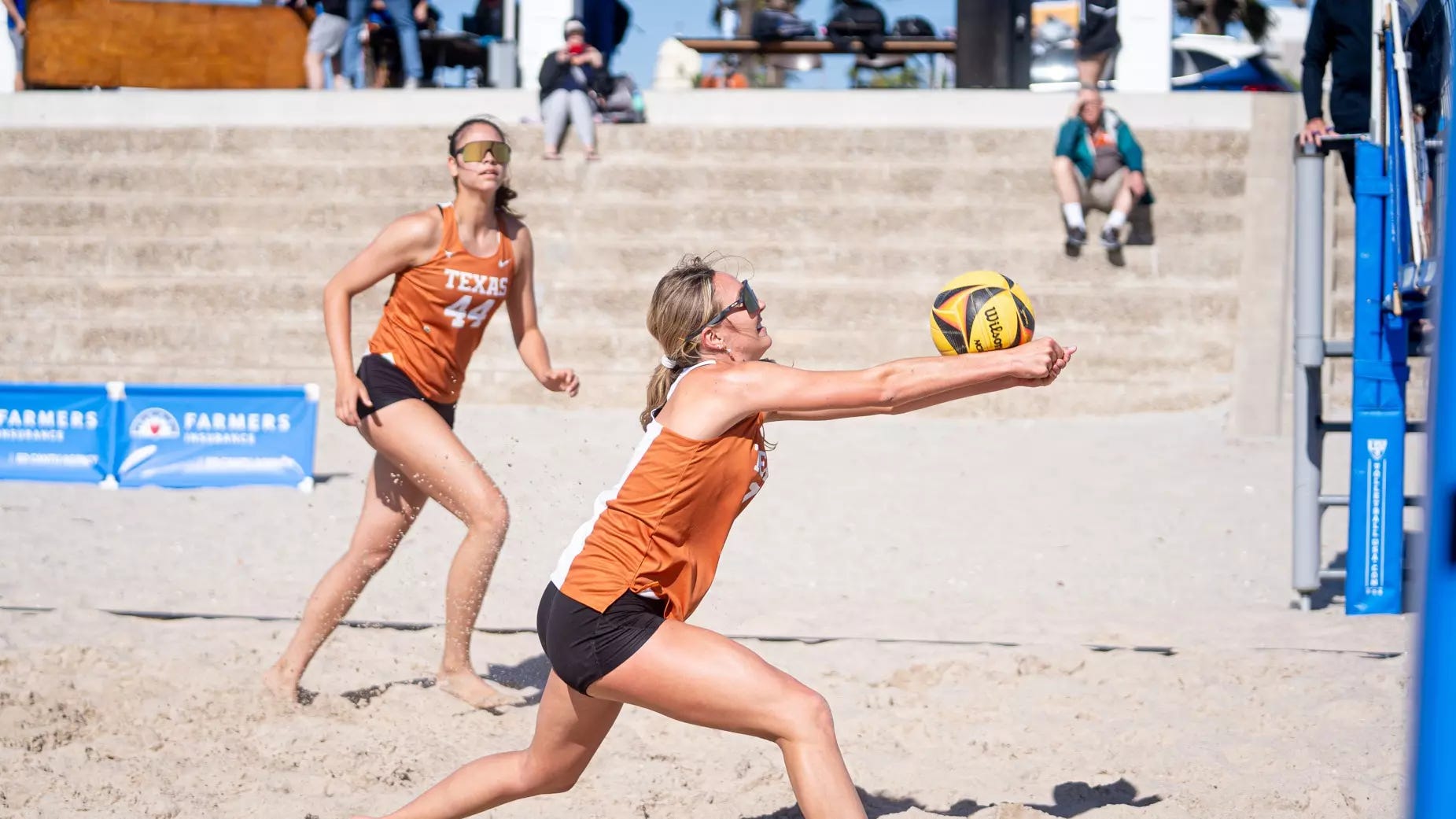
Coach Stein Metzger’s Texas beach volleyball program is finally queued up for the 2026 season. The Sandhorns (patent pending on that nickname that I just made up) open play on Thursday, February 19th down on O’ahu as part of the Outrigger Duke Kahanamoku Beach Classic. Texas will face off with UCLA, Hawaii, Cal, Loyola Marymount, Stanford, and USC before putting on the Orange/White Scrimmage back home in Austin on February 28th.
In the program’s first official year, Texas entered the NCAA tournament ranked #7 in the country, ultimately falling to eventual national champion TCU in the quarterfinals.
In addition to indoor fan-favorite Devin Kahahawai making the transition to beach volleyball, the Longhorns feature returning players in 2025 CCSA All-Freshman Team members Eva Liisa Kuivonen and Noa Sonneville. Junior Macey Butler, Sonneville’s partner on the #4 pair last year, also returns. #3 pair member Karin Zolnercikova is also back for one last year in the 512 as are both halves of the #2 pair in Emma Grace Robertson and Katie Hashman. Ava Patton rounds out the returnees from last season’s opening match starting lineup.
We’ll do our best to keep everyone in the loop as the season progresses, but we do unfortunately currently lack the capacity and knowledge to be able to track the beach team as well as we tracked indoor last fall. Maybe someday soon enough, that will change?
Hook ‘em!